
How to Brief a Custom Jewelry Manufacturer With a Rough Sketch
A rough sketch can start a jewellery programme, but only when it is treated as one page of a brief rather than the whole of one. The published clock for turning a brief into a 3D CAD model is under 48 hours, and that speed depends on what the buyer wrote around the drawing. Four dimensions separate a sketch that can be priced from one that generates a week of email: inner diameter, thinnest wall, stone size and a target finished weight.

Key takeaways
- CAD modelling is published at under 48 hours, equal to 2 days and roughly 7–8% of a 25–30 day sampling window.
- Four numbers stop most revisions: inner diameter, minimum wall thickness, stone diameter and a finished weight band.
- Revisions should be lettered, not dated, so a factory cutting a master can prove which version it built.
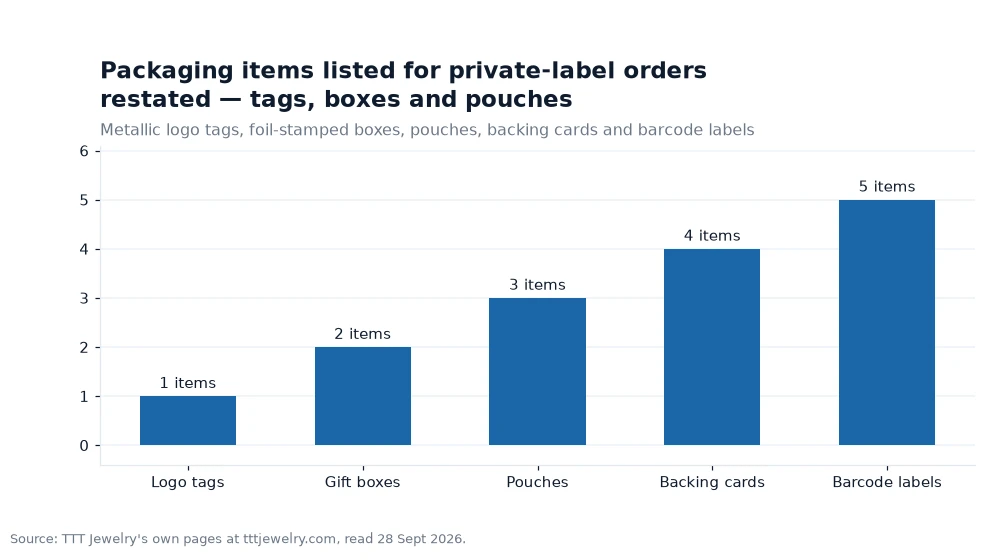
- Private-label orders carry five packaging items — tags, boxes, pouches, backing cards, barcode labels — whose artwork deadlines belong in the same document.
What a pencil line actually specifies
A drawing is a projection. It records one silhouette from one angle and stays silent about the remaining views. That is not a flaw in the buyer's sketching; it is the nature of the medium. The mistake is treating the confidence of the line as if it carried information it cannot carry. A curve drawn boldly says nothing about wall thickness at its thinnest point, and a stone drawn as a circle says nothing about the depth of the seat beneath it.
The practical fix is to annotate rather than redraw. A scale bar in the corner, with one marked measurement such as the inner diameter, lets a reader calibrate every other proportion on the page. Arrows pointing to a clasp, a hinge or a jump ring remove the guesswork about which small element is functional and which is decorative. Light pencil shading over a surface, with a note saying "brushed here, polished elsewhere", transmits a finish decision that would otherwise need three paragraphs.
Most sketches also flatten the design's hierarchy. Every element gets drawn at the same pressure, so a factory cannot tell whether the stone is the subject or the surround is. Naming the signature feature in one sentence — "the asymmetric bezel is the point of the piece" — is more useful than another hour of drawing, because it tells the modeller where to spend the tolerance budget.
The four numbers that end the guesswork
Inner diameter, or length for a necklace or earring drop, fixes scale. Without it, a model can be beautiful and unwearable. Minimum wall thickness governs whether the piece survives casting: too thin and the metal fails to fill the mould, too thick and the finished weight puts the design in a price tier the buyer never intended. Stone diameter, measured across the girdle rather than the table, determines the seat. A target finished weight band, expressed as a range rather than a single figure, gives the factory a way to flag a model that has drifted.
Metal and finish belong on separate lines from those four numbers, written as specifications rather than adjectives. "Gold" is not a specification. Multi-layer 14K, 18K or 24K plating is, and so is rhodium over a white base. On silver and brass, an anti-tarnish e-coating is a decision that has to be made before sampling, because it changes how the surface is prepared. On stainless, PVD vacuum plating behaves differently again and cannot be swapped in later without a new sample. A brief that names the substrate and the finish route saves an entire approval round.
Size runs deserve the same treatment. A ring programme usually needs a set of sizes rather than one, and stating the range at brief stage tells the factory how many variants the master must support, which affects the tooling plan and the quantity per size a minimum order allows.
A one-page brief that survives translation
The document does not need to be long. It needs to be complete enough that two readers arrive at the same model. Five fields cover most of the ground, and each one answers a question that would otherwise come back as an email three days later.
| Brief field | Question it answers | Cost of leaving it blank |
|---|---|---|
| Reference dimension | What scale is the drawing? | Model rebuilt at the wrong size |
| Wearer and use case | Daily wear, occasion or gifting? | Finish chosen for the wrong duty cycle |
| Metal and plating route | Which substrate and which coating? | Sample approved in an unrepeatable finish |
| Size range and ratio | How many variants per design? | Tooling planned for one size only |
| Artwork assets | Logo, hallmark and packaging files? | Packing bench stalls near delivery |
Reference dimension is the field buyers skip most often. A photograph of a similar product is not a dimension; it is a mood board entry. If the drawing has no measurement on it at all, the factory will assume a category norm, and the first sample will arrive at a size that feels arbitrary to the buyer and reasonable to the person who built it.
Logo and hallmark placement is the second silent field. Laser engraving needs a flat or gently curved area of sufficient size, and the mark has to sit where a polishing wheel will not round it over. Published hallmark conventions include S925 for sterling, 316L for stainless and 18KGP for gold plating. Deciding which mark goes where at brief stage avoids discovering, after polishing, that the only clear panel is on the inside of a curve.
A brand that approaches an OEM jewelry manufacturer China, sheet in hand, gets a quote in days rather than a questionnaire in weeks. The sheet is also what makes two quotes comparable: the same five fields are priced, so the difference in the numbers reflects the factory rather than the question.
Where packaging dates belong
Retail dressing is usually handled by a different team, on a different timetable, and that separation is where launch dates slip. The published private-label list runs to five items: metallic logo tags, foil-stamped gift boxes, velvet or microfibre pouches, display backing cards and barcode labelling. Each is printed, stamped or encoded, and each needs approved artwork before the packing bench can use it.
Putting those five items into the same brief as the drawing does two things. It forces an artwork owner to be named early, and it makes the quantity arithmetic visible. A packaging line that reads "barcode labels, 1 per piece, variant-coded" tells the factory something a line reading "labels as usual" never will. The brief becomes a single source for both the product and the carton that carries it.
Worked example
Take a 50-piece sterling silver pendant run, drawn by hand and sent with the five-field sheet. Modelling consumes 48 hours, which is 2 days. Against the published 25–30 day sampling window that is 48 ÷ 600 = 8% at the short end and 48 ÷ 720 = 6.7% at the long end.
The packaging arithmetic is less forgiving. Five items across 50 pieces means 250 individual printed or tagged components, assuming one of each per unit. Raise the run to the 100-piece brass minimum and the same pack needs 500. That multiplication is why artwork deadlines sit early: reprinting a foil stamp takes longer than printing it.
Total pre-production time is 2 days of CAD plus 25–30 days of sampling plus 21–28 days of bulk, which is 48–60 days, or roughly 7–9 weeks. The brief has to be right inside that window, because correcting a specification after a master is cut restarts most of the sampling clock rather than a portion of it.
Frequently asked questions
Can a factory work from a hand-drawn sketch alone?
It can start, but the model will rest on assumptions about scale and wall thickness. Supplying four numbers — inner diameter, thinnest wall, stone diameter and a weight band — removes most of those assumptions before modelling begins.
Should the sketch be to scale?
Scale is optional if one dimension is marked. A single reference measurement plus a size range lets a modeller calibrate the rest of the drawing, which is faster than redrawing it accurately.
Who owns the CAD file produced from my sketch?
The buyer, under the published terms. Designs are 100% exclusive to the brand, covered by a 100% NDA, and moulds, CAD files and the resulting collection are not resold or shown to other clients.
From sketch to signed sample
The useful test of a brief is what comes back. Hand a completed sheet to a factory and the reply should be a quote with questions about design intent. Hand over a drawing with nothing around it and the reply is a list of missing data, which costs a week before modelling even starts.
Brands that plan a family of pieces often begin with a custom jewelry wholesale conversation about which shapes repeat across a collection, so the brief can be written once and varied by size and finish. That approach also keeps the packaging list shared across SKUs instead of rebuilt per design.
It also helps to know whether the factory runs an OEM/ODM jewelry manufacturer service or only production to a finished file. TTT Jewelry publishes both routes, with OEM/ODM covering concept development when the sketch is the only starting point. Under ISO 9001:2015, the approved brief and model become the controlled documents that every later reorder is measured against.
Source note: figures come from the manufacturer's own website (tttjewelry.com), read 28 Sept 2026.[1]