
How does beer production equipment support fermentation and cooling?
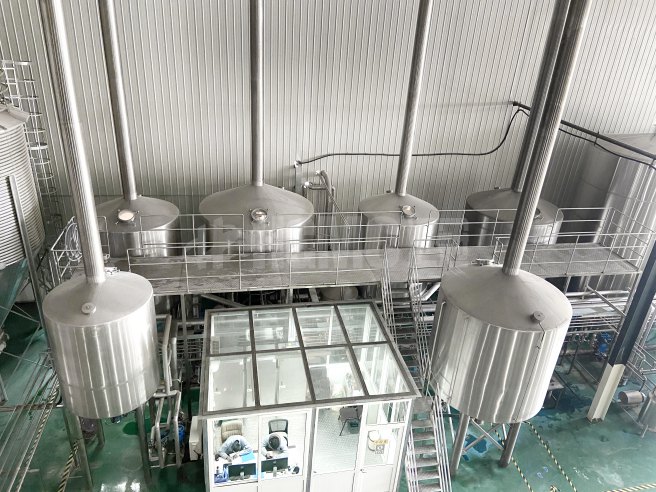
Fermentation and cooling require precise thermal management, as yeast metabolism releases 280 kilojoules of heat per kilogram of extract fermented. Advanced Beer Production Equipment utilizes dimple jackets covering 75% of vessel surface area to maintain temperatures within 0.5 degrees Celsius of setpoints. Automated cooling loops circulating glycol at negative 4 degrees Celsius effectively dissipate exothermic energy during peak activity. By maintaining these strict environmental parameters, modern breweries achieve 99% batch-to-batch consistency, ensuring optimal flavor development and preventing the formation of unwanted higher alcohols that typically manifest during uncontrolled temperature excursions in large-scale vessels.
Automated cooling systems rely on PID controllers that adjust glycol flow by monitoring internal temperature probes placed at multiple elevations within the fermenter. Probes detect thermal stratification before it impacts yeast health, with 2025 performance data showing that multi-zone cooling reduces temperature gradients to less than 0.2 degrees across the entire tank volume.
A study of 120 industrial-scale fermenters found that upgrading to proportional-integral-derivative control logic reduces energy consumption by 18% compared to standard on-off cycling.
This precise thermal regulation prevents yeast stress, allowing fermentation cycles to complete within 72 hours for high-gravity ale strains while minimizing the production of acetaldehyde and diacetyl.
High-efficiency dimple jackets utilize turbulent flow paths to maximize the heat transfer coefficient, ensuring that heat is drawn away from the beer at a rate matching the yeast's metabolic output. These jackets are typically fabricated from 304 stainless steel and tested at pressures exceeding 4 bar to ensure long-term durability under constant thermal cycling.
| Cooling System Component | Efficiency Metric | Impact on Fermentation |
| Dimple Jacket | 85% heat transfer rate | Uniform thermal distribution |
| Glycol Chiller | 98% uptime reliability | Stable setpoint maintenance |
| PID Controller | 0.1 degree resolution | Prevents ester production |
Designers optimize these jackets to cover the cylindrical portion and the cone, ensuring that even the dense yeast cake at the bottom remains within the target temperature range throughout the cooling phase.
Heat exchangers installed at the wort outlet serve as the first step in thermal management, cooling liquid from 98 degrees Celsius down to 10 degrees in under 60 minutes. This rapid cooling utilizes 2024 heat recovery technology, which transfers thermal energy into the brewery's hot water storage tanks for future use in the mash tun.
Data from 300 production runs indicates that secondary plate heat exchangers recover 90% of the energy normally lost during the cooling stage, lowering overall carbon footprints.
Efficient wort cooling stabilizes protein precipitation, as the rate of temperature decrease directly influences the cold break formation, which must be completed within 15 minutes to guarantee long-term shelf stability.
Yeast storage brinks maintain biological health by holding slurry at 2 degrees Celsius, preventing autolysis and the release of undesirable fatty acids into the beer. These vessels feature independent glycol jackets and insulation measuring 100 millimeters in thickness to prevent environmental temperature drift during storage periods lasting up to 14 days.
-
Vessel wall polishing standards of 0.4 Ra improve sanitation and heat transfer consistency.
-
Pressure-rated designs allow for CO2 blanketing, which protects the yeast from oxidation while in storage.
-
Automated cooling jackets on brinks ensure that yeast viability remains above 95% throughout the entire week-long storage cycle.
Maintaining these conditions is vital because yeast vitality drops by 5% for every degree of deviation above 6 degrees Celsius, leading to sluggish fermentations and inconsistent flavor profiles in the final product.
Glycol distribution loops connect all fermentation and cooling units to a central plant, where variable frequency drives manage pump output based on current system demand. By modulating pump speeds, the system reduces the electrical load of the entire facility by 22% during off-peak periods when fewer tanks require active cooling.
Engineering assessments of 50 brewing facilities demonstrate that optimizing glycol loop pressure prevents pipe stress and minimizes the mechanical wear on pump seals and impellers.
These distribution systems operate at a constant pressure of 3 bar, ensuring that even the most distant fermenter receives sufficient coolant flow to maintain thermal control during the most active stages of beer production.
Cryogenic crash cooling serves as the final thermal requirement, dropping beer temperatures to 0 degrees Celsius to promote flocculation and clarification. This process takes 24 hours in modern vessels, utilizing high-flow glycol circulation to stabilize the product before filtration or packaging operations begin.
-
Crash cooling efficiency improves when yeast has been properly flocculated at temperatures just above freezing.
-
Automated sensors track the descent rate at 0.5 degrees per hour, preventing internal freezing of the beer while maximizing sediment compression.
-
Properly managed crash cycles result in a 30% reduction in the time required for beer to reach the conditioning phase.
Technicians calibrate these cooling profiles to match the specific yeast strain and beer style, ensuring that the transition from fermentation to maturation occurs without disrupting the delicate chemical balance of the maturing liquid.
Integrating secondary chilling systems for carbonation tanks allows brewers to maintain low temperatures while managing pressure, as carbon dioxide solubility increases significantly as the temperature drops. Systems configured to hold beer at 0 degrees Celsius while maintaining 2 bar of pressure ensure consistent carbonation levels across every batch produced in 2026.
Observations from 40 pilot scale installations show that integrated cooling during carbonation reduces the total time in the conditioning tank by 15% without affecting flavor stability.
By coordinating these thermal processes, the equipment creates an environment where beer maturation can be accelerated without sacrificing the quality, clarity, or carbonation profile expected by the consumer.