
Sample Rounds in a First Seasonal Order: A Founder's Walkthrough
A first seasonal order is usually not decided by the quote; it is decided by how the sample rounds are run. Each round is a fork: keep the direction, narrow it, or start again. Founders who treat the first submission as a product to approve rather than a question to answer tend to spend the season negotiating changes instead of shipping. The walkthrough below shows what to decide, what to write down, and when to stop.
Key takeaways
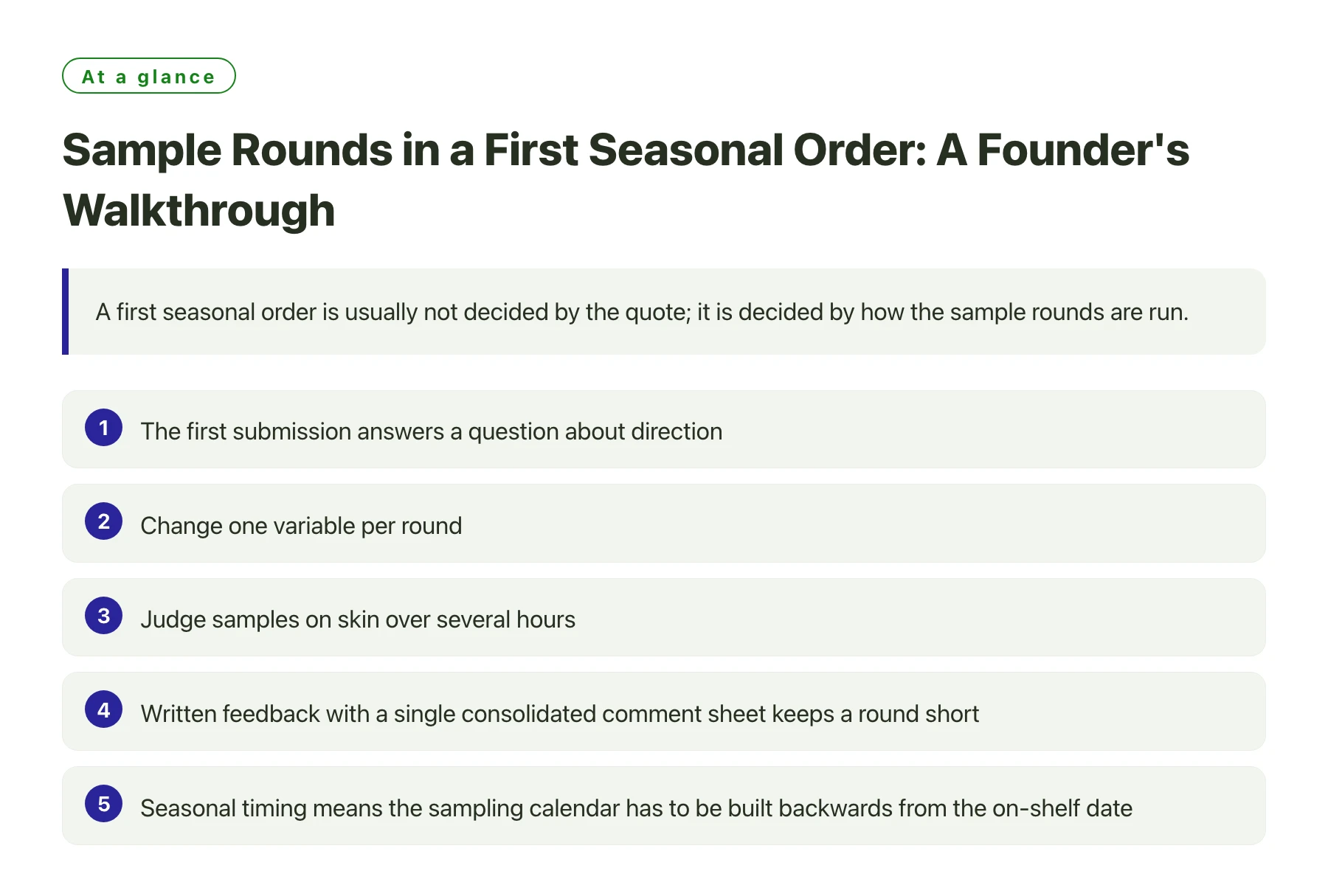
- The first submission answers a question about direction; approving it as a final product is the most expensive mistake in a first sampling cycle.
- Change one variable per round, because a submission that moves dosage, materials and format at once cannot tell you which change worked.
- Judge samples on skin over several hours, not only on blotter, and note the hour at which each impression was taken.
- Written feedback with a single consolidated comment sheet keeps a round short; feedback sent in pieces over a week effectively adds a round.
- Seasonal timing means the sampling calendar has to be built backwards from the on-shelf date, with decoration and packaging treated as fixed commitments.
- A sign-off should name the standard being approved, including fill weight, format and batch reference, so the bulk order has something to match.
There is a specific kind of fatigue that sets in during a first fragrance development cycle. Samples arrive, everyone smells them, opinions differ, a revised set arrives three weeks later, and the calendar that looked comfortable in the first month now has no slack. The fatigue is usually caused by process rather than by the fragrance.
Most founders arrive at sampling with one clear question: does this smell good enough to sell. It is the right question and the wrong moment for it. The sampling phase exists to narrow a direction, then to confirm a version, then to fix a standard. Those are three different decisions, and each one benefits from being answered before the next begins.
This walkthrough follows a first seasonal order through those decisions. It is written for a founder running the project alone, which is the situation where disciplined rounds pay off most.
Before the first sample arrives
The work that decides the sampling phase happens before it starts. Write a brief that states the product, the wear behaviour you want, the retail price band, the target markets and the formats in the range. Two or three reference scents help more than adjectives, because a perfumer can decode a reference quickly and cannot decode a paragraph of moods. It is also worth reading Xuelei's guide before the brief is written, since the sequence makes it clear which decisions have to be fixed early and which can wait.
Also decide who approves. One person should hold the final call, even if several people give input. A committee can widen a direction usefully and cannot close one, and a sampling cycle without a closing mechanism runs until the money or the calendar runs out.
Set a submission plan, not just a deadline
Ask the supplier for a submission plan: how many candidate directions in the first set, how many adjustments in the second, and what the supplier needs from you to start each round. A plan with named rounds turns an open-ended search into a schedule you can hold the project against.
What each round is actually for
- Round one: choose a directionExpect several candidates built on the same brief. Your decision is not which smells best but which family you want to develop, so rank by fit with the brand and the price band rather than by personal preference.
- Round two: correct one thingPick one variable to move, such as dosage, a specific material, or the balance between freshness and warmth. Two simultaneous changes make the next comparison meaningless.
- Round three: confirm the versionBy now the direction should be settled. This round checks that the adjustment landed and that the formula still behaves as intended at the intended concentration.
- Wear test: judge it in useTest the confirmed version on skin over a working day, on more than one person, and record impressions by hour rather than as a single verdict.
- Sign-off: fix the standardApprove a named version with its fill weight, format and reference, and ask for the retained standard you will compare the bulk batch against.
- Buffer round: protect the calendarKeep one unused round in the schedule. Seasonal projects that use every available round have no room for a problem that appears late.
How to read a sample without fooling yourself
Fragrance is the hardest product category to evaluate casually, because perception changes with time, temperature and the surface it is applied to. A formula judged on paper in the first ten minutes rewards brightness and says almost nothing about how it will wear. It also helps to place the sample in its production context, because Xuelei shows how much can still change after approval, from compounding scale to filling and resting.
The structure of a fragrance explains why. Lighter materials leave the surface early and heavier ones stay, so what you smell in the opening is not what a customer will smell two hours later [1]. Judge the opening and the dry-down as separate qualities, and write down which one you are reacting to.
Testing many samples in one sitting is another trap. After four or five scents the nose stops discriminating, and the fifth judgement is mostly fatigue. Test in small sets with a gap, and keep a reference scent to re-anchor your nose between them.
When a material or an odour family is unfamiliar, look it up rather than guessing. Public material databases describe individual aroma materials and their reported odour profiles, which makes feedback more useful than the word interesting [2].
Feedback that shortens a round
A round only starts when the supplier has complete feedback. If comments arrive from three people on three different days, the perfumer either starts work on partial information or waits, and the schedule absorbs both.
Use one comment sheet. For each sample, record: keep or drop, what the direction is missing, what it has too much of, how it behaved by hour, and any hard constraints such as a restricted material or a cost ceiling. Keep opinions separate from requirements, so the perfumer can see which comments are negotiable and which are not.
Abstract language costs time. Saying it needs more lift means the perfumer has to guess whether you mean brightness, projection or diffusion. Saying the opening fades within twenty minutes is a fact that can be worked on.
Where first-time founders lose the season
The first loss is approving a sample because it is good enough and the calendar is tight. That decision is understandable and it usually converts a development problem into a production problem, because a fragrance that was never pushed to the intended performance will be compared against better products on the shelf.
The second loss is treating the range as a single project. A seasonal collection with four formats needs an approval per format and a check that the same fragrance reads consistently across them. Founders who sample only the hero format often discover the range problem during the bulk order.
The third loss is a missing paper trail. If nobody wrote down which version was approved, the bulk order has no reference, and the first batch becomes the standard by default. Founders who want to see how a manufacturer describes the whole sequence, from idea to first order, can read the development notes published by Xuelei Fragrances, where the stages are set out in order.
None of this requires a large team. It requires deciding what each round is for, writing down the answer, and keeping one person accountable for the calendar.
Label every sample the day it arrives with the date, the version number and the supplier. Samples that are judged unlabelled cannot be re-checked later, and a seasonal decision that cannot be re-checked usually gets made twice.
Sources
- Wikipedia: Perfume —— An encyclopaedic overview of perfume covering definitions, history, the note structure of a fragrance and concentration terminology (background reference only).
- The Good Scents Company —— A reference database of aroma materials with odour descriptions, CAS numbers and typical usage information.
Frequently asked questions
How many sample rounds does a first seasonal fragrance order need?
Two to three development rounds plus a wear test is typical for one format. Seasonal ranges with several formats usually need a confirmation round per format, so allow for more rounds than a single-format project even when the fragrance is shared.
Should I approve the first sample if it already smells right?
Only after a wear test on skin over several hours and a check that the formula meets the brief's performance and cost targets. A first submission is usually built to answer a direction question, and it may not yet be adjusted for the price band.
Why do my revised samples keep moving in the wrong direction?
Usually because the feedback was ambiguous or because more than one variable changed at once. State observations rather than adjectives, and restrict each round to a single change so the next comparison is informative.
What should be recorded at sign-off?
The version approved, the fill weight and format, the date, the person approving, and the reference sample retained for comparison. That record is what makes the bulk order checkable.
How much calendar buffer should a seasonal sampling plan keep?
At least one unused round and enough time for decoration and packaging to follow. Sampling rarely overruns by design; it overruns because a revision was needed at the point when the schedule had stopped being flexible.